In, From, and To Space: What It Takes to Fight in the Ultimate High Ground


This is part 4 of a 4-part series.
Space Power as a Joint Imperative
The U.S. Space Force was founded to secure national interests in, from, and to space. These three prepositions are more than mission statements—they define how we compete in today’s high-stakes, “Space Race.” Yet the effectiveness of this mission depends not only on capability, but on integration.
Senior defense leaders and combatant commands must understand how each aspect of this mandate contributes to deterrence, operational advantage, and strategic success. In this post, we examine how the U.S. must organize, invest, and fight across these dimensions, and where gaps remain.
Operating in Space: Understanding and Responding in a Congested Domain
Operating in space means safeguarding U.S. assets in an increasingly contested environment. Since 2008, the number of tracked objects in orbit has increased nearly threefold. These objects occupy different orbital regimes and are controlled by a mix of allies, commercial partners, and adversaries.

“There’s a lot going on up there … objects of various sizes, different orbital regimes, and operated often by adversaries as well as ourselves.”
Dave Meteyer, SPA Group Leader in the Space & Intelligence Division
This makes Space Domain Awareness (SDA) not just a technical task but an operational imperative. SDA enables decision-makers to distinguish benign from threatening behavior, identify patterns of life, and prioritize threats as well as effectively and efficiently command and control our own space systems.
To operate effectively in this environment, the U.S. must:
- Expand and enhance SDA & C2 capabilities to ensure optimal coverage of all orbital regimes
- Train Guardians to interpret and act on ambiguous space behavior
- Develop operational concepts for maneuver, avoidance, and escalation control
Delivering Effects from Space: The Backbone of Joint Operations
Space-enabled effects—from ISR (intelligence, surveillance, and reconnaissance) to missile warning to communications—are essential to joint and combined operations. As Meteyer noted, “The ISR that we provide the terrestrial forces, the PNT, the communication to do effective command and control – all of those services greatly enhance the other domains.”
Yet these capabilities are increasingly at risk. Hostile electronic warfare, directed energy, and kinetic threats can degrade or deny access to key services. Safeguarding these effects requires resilient architectures, integrated risk assessments, and clear operational dependencies across all domains.
The priority now is ensuring these effects are designed for redundancy, survivability, and flexibility in contested environments—not just performance in benign ones.
To strengthen this mission area, the U.S. must:
- Prioritize hybrid architectures that blend commercial, international, and government assets
- Design resilience into ISR, missile warning, PNT (positioning, navigation, and timing), and SATCOM
- Integrate space-based effects into joint operational planning, wargaming & exercises
Projecting Power to Space: Ensuring Responsive Access
The ability to replenish, augment, or surge space capabilities rapidly is a critical element of deterrence and operational advantage. As Meteyer explained, “The ability to get to space quickly has changed drastically over the last 10 years and consequently has created a more viable opportunity to assess responsive launch as part of military planning.”
To meet this need, tactically responsive launch systems, modular payloads, and adaptable acquisition frameworks must move from concept to execution. Launch responsiveness is not just a technical challenge—it is a planning imperative.
To project power to space, the U.S. must:
- Fund tactically responsive space programs – from acquisition through testing to launch and on-orbit operations
- Align acquisition timelines with operational urgency
- Incorporate replenishment planning into force design and wargaming
Integrating with Combatant Commands: Closing the Operational Loop
The final measure of space power is its integration into joint operations. Guardians cannot deliver strategic effects if space isn’t embedded in the Combatant Command (CCMD) planning and execution cycle.
“Sufficient Guardians embedded within Combatant Commands are key to ensuring space is fully represented in joint warfighting plans and effectively employed in Joint operations.”
Dave Meteyer, SPA Group Leader in the Space & Intelligence DivisionWhile Guardians currently support operations and planning across CCMDs, but gaps remain—integration is inconsistent, space understanding among joint planners varies, and operational planning often fails to fully account for contested space environments. SPA helps close these gaps by supporting space-inclusive CONOPS, modeling degradation scenarios and simulation efforts, and enabling enhancing joint exercises that simulate orbital threats with Space Warfare inputs and effects.
To institutionalize this integration, the U.S. must:
- Formalize sufficient Guardian billets across CCMD J-code staffs
- Expand education on of space effects for joint planners
- Update doctrine to fully reflect space as a contested, decisive domain
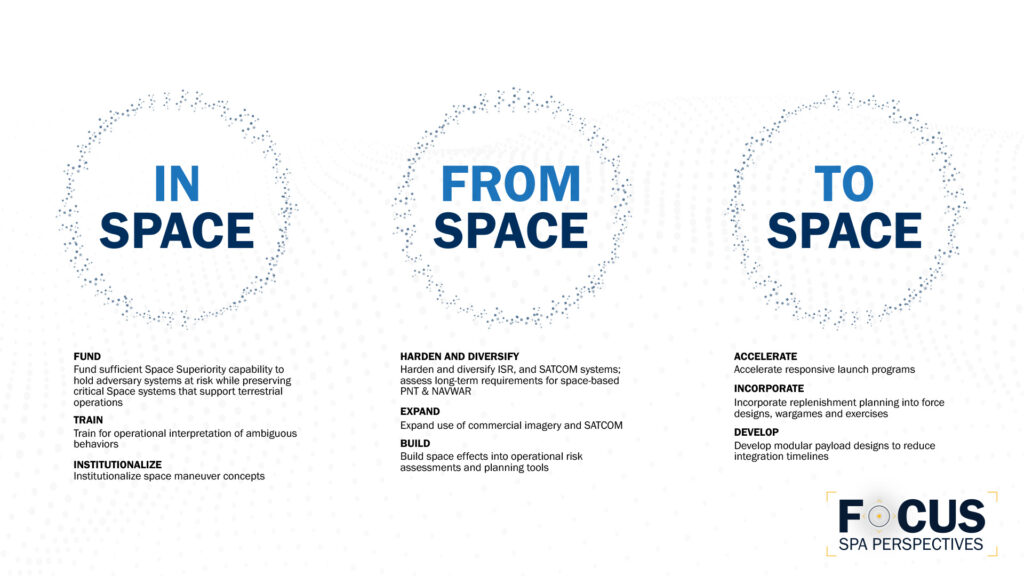
What the U.S. Must Do—By Mission Area
In Space
- Fund sufficient Space Superiority capability to hold adversary systems at risk while preserving critical Space systems that support terrestrial operations
- Train for operational interpretation of ambiguous behaviors
- Institutionalize space maneuver concepts
From Space
- Harden and diversify ISR, and SATCOM systems; assess long-term requirements for space-based PNT & NAVWAR
- Expand use of commercial imagery and SATCOM
- Build space effects into operational risk assessments and planning tools
To Space
- Incorporate replenishment planning into force designs, wargames and exercises
- Incorporate replenishment planning into force designs, wargames and exercises
- Develop modular payload designs to reduce integration timelines
04
CCMD Integration
- Embed sufficient Guardians in J2, J3, J5, J7, and J8 teams
- Add rapid threat response to joint training scenarios
- Adjust OPLAN templates to include space degradation pathways
The Strategic Time Horizon
Decisions made in the next 12–18 months will shape U.S. posture in 2030 and beyond. Threats are accelerating. Systems being procured today must be resilient and responsive. And if space is not fully normalized in joint planning by FY26, the U.S. will enter future conflicts at a disadvantage.
The High Ground Must Be Operationalized
The “in, from, and to” framework offers more than mission clarity—it defines the strategic actions the U.S. must take now. Without targeted investment, training, and integration, space risk will remain a vulnerability rather than a domain of strength.
Achieving this vision will require coordinated leadership across acquisition, operations, and strategy. SDA, architectural foresight, and integration into the joint force are not optional enhancements—they are the foundation of readiness.
The next fight may begin in orbit. We must be ready to shape it—and win it—together.
Review previous posts in this series and subscribe today to be informed of the final post.
Subscribe to our newsletter
We respect your privacy.
[ Related Articles ]